

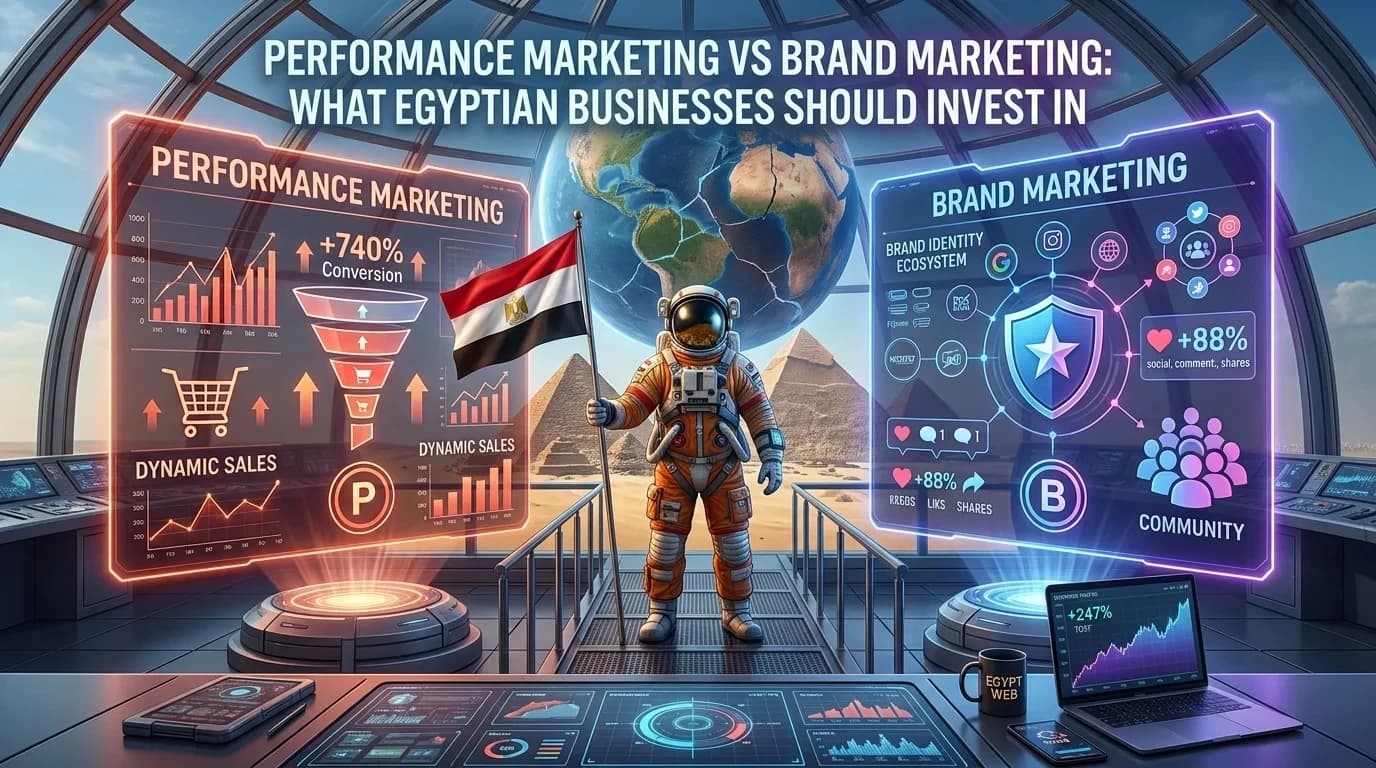
For Egyptian businesses, choosing where to put the marketing budget is rarely a simple decision. Performance campaigns can generate leads, sales, and measurable results, while brand marketing can build awareness, trust, and preference over time. The real question behind performance marketing vs brand marketing is not which one is better, but which role each should play in the business growth plan. Performance marketing focuses on capturing existing demand and driving measurable actions, while brand marketing helps create future demand by making the business more recognizable and memorable. For companies operating in Egypt’s competitive digital market, understanding how both work together can lead to smarter budget allocation and more sustainable growth.
What Is Performance Marketing and How Does It Work?
Performance marketing is built around measurable business outcomes. Instead of judging a campaign mainly by how many people saw it, marketers track actions such as leads, purchases, registrations, calls, or other defined conversions. Common channels include Google Ads, Meta Ads, TikTok, LinkedIn, affiliate marketing, and retargeting. This makes performance marketing Egypt a particularly relevant approach for businesses that need to generate demand and evaluate campaigns quickly. Metrics such as CPA, CPL, conversion rate, customer acquisition cost, and ROAS help marketers identify what is working and where budgets should move. The advantage is speed and accountability, but focusing only on immediate conversions can limit long-term brand growth.
What Is Brand Marketing and Why Does Brand Awareness Matter?
Brand marketing focuses on shaping how people recognize, remember, and perceive a business. Instead of asking the audience to buy immediately, it creates associations that can influence future purchase decisions. Brand awareness campaigns may use video, social content, influencer collaborations, PR, events, outdoor advertising, or other channels designed to reach potential customers before they actively search for a product. Brand investment is harder to connect directly to one transaction because the effect often develops over time. However, strong brand recognition can make future campaigns more effective by giving customers a reason to notice, trust, and consider a company instead of treating every purchase decision as a completely new interaction.
Performance Marketing vs Brand Marketing: What’s the Difference?
The main difference is the business problem each approach is designed to solve. Performance marketing primarily captures demand and turns existing intent into measurable actions. Brand marketing works earlier in the customer journey by creating awareness, familiarity, and preference. Performance campaigns are commonly evaluated through conversions, CPA, CPL, ROAS, and revenue, while brand activity can be evaluated through reach, awareness, consideration, search interest, direct traffic, and brand lift. The two approaches therefore operate on different timelines and should not always be judged by the same KPI. Treating them as competitors can create an unnecessary budget debate when the stronger strategy is to connect their roles across the customer journey.
Performance Marketing vs Brand Marketing by Funnel Stage
At the top of the funnel, businesses need to reach people who may not yet know the brand. Brand content and awareness campaigns can introduce the company and establish a clear position. During consideration, educational content, social proof, reviews, and targeted messaging can help customers evaluate their options. At the conversion stage, performance campaigns can retarget engaged audiences and push them toward a measurable action. This relationship is the foundation of a full funnel marketing strategy, where awareness, consideration, and conversion are connected rather than managed as isolated campaigns.
Performance Marketing vs Brand Marketing: Which One Delivers Better ROI?
There is no universal winner because the answer depends on what the business defines as return. Performance marketing usually provides clearer short-term attribution, making it easier to connect spending with leads, purchases, or revenue. Brand marketing has a longer feedback cycle, so its contribution may appear through increased branded searches, direct traffic, consideration, repeat purchases, or stronger conversion performance later. This means marketing ROI should not be calculated from one campaign metric alone. A business that measures every decision only through immediate ROAS may underestimate demand creation, while a business focused only on awareness may struggle to connect marketing investment with commercial outcomes. The better approach is to evaluate both short- and long-term business impact.
When Should Egyptian Businesses Invest in Performance Marketing?
Performance marketing is particularly valuable when a business has a clear offer, a defined target audience, reliable conversion tracking, and a sales process capable of handling incoming demand. It can be a strong starting point for e-commerce brands, lead-generation businesses, service providers, and companies launching offers where the desired customer action can be measured. For businesses searching for performance marketing Egypt, the important question should not simply be which platform to advertise on, but whether the website, landing page, creative, offer, tracking, and sales process are ready to convert traffic. Increasing ad spend without fixing those fundamentals can increase costs without creating proportional growth.
How to Build a Full-Funnel Marketing Strategy for Sustainable Growth
A sustainable strategy connects brand-building activity with performance execution instead of putting them into separate silos. An Egyptian business might use video and social content to introduce its positioning, educational content to answer customer questions, search campaigns to capture active demand, and retargeting to convert people who have already interacted with the brand. Over time, performance data can also improve creative and messaging decisions across the funnel. This is where growth marketing Egypt becomes more than simply running advertisements: it combines acquisition, experimentation, customer behavior, conversion optimization, and retention into one connected growth system. Research from McKinsey also supports integrating brand building and performance rather than treating them as competing disciplines.
How to Measure Marketing ROI Across Brand and Performance Campaigns
Measurement should start with business objectives rather than platform dashboards. For performance activity, businesses can monitor metrics such as qualified leads, customer acquisition cost, conversion rate, revenue, and ROAS. For brand activity, useful indicators can include awareness, branded search demand, direct traffic, engagement quality, consideration, and customer research. The goal is not to force every metric into one formula, but to understand how different activities contribute to growth. A strong measurement framework can also compare results over time and identify whether increased awareness is influencing downstream behavior. This creates a more realistic view of marketing ROI than judging an entire marketing strategy from a single campaign or advertising platform.
Build a Marketing Strategy That Balances Growth and Brand
The strongest answer to performance marketing vs brand marketing is rarely choosing one and eliminating the other. Egyptian businesses need performance marketing when they must capture demand and generate measurable commercial results, but they also need brand investment to create familiarity and future demand. The right balance depends on the business model, growth stage, category, competition, customer journey, and available budget. If your campaigns generate short-term results but your acquisition costs continue rising, the problem may be a lack of demand creation. If your brand receives attention without generating meaningful business outcomes, the strategy may need stronger conversion layers. A connected approach allows both sides to support sustainable growth.
Frequently Asked Questions About Performance and Brand Marketing
Is performance marketing better than brand marketing?
Neither is universally better. Performance marketing is usually stronger for measurable short-term actions such as leads and sales, while brand marketing supports awareness, trust, and long-term preference. Businesses often achieve better results when both are connected within the customer journey instead of treating them as mutually exclusive strategies.
Can a small business use both performance and brand marketing?
Yes. A small business does not necessarily need a large budget to use both. The key is assigning each activity a clear role. A focused performance campaign can generate measurable demand while consistent brand content builds recognition and credibility around the same audience and positioning.
How long does brand marketing take to show results?
Brand marketing usually takes longer to evaluate than performance campaigns because awareness and preference develop over repeated interactions. The timeframe depends on the category, audience, creative quality, media reach, and competitive environment. Businesses should therefore establish appropriate brand metrics instead of expecting immediate sales from every awareness campaign.
What is the difference between ROAS and marketing ROI?
ROAS measures revenue generated relative to advertising spend, while ROI is a broader financial measure that considers the return from an investment against its associated cost. ROAS can therefore be useful for evaluating advertising efficiency, but it does not necessarily represent the complete profitability of a marketing program.