

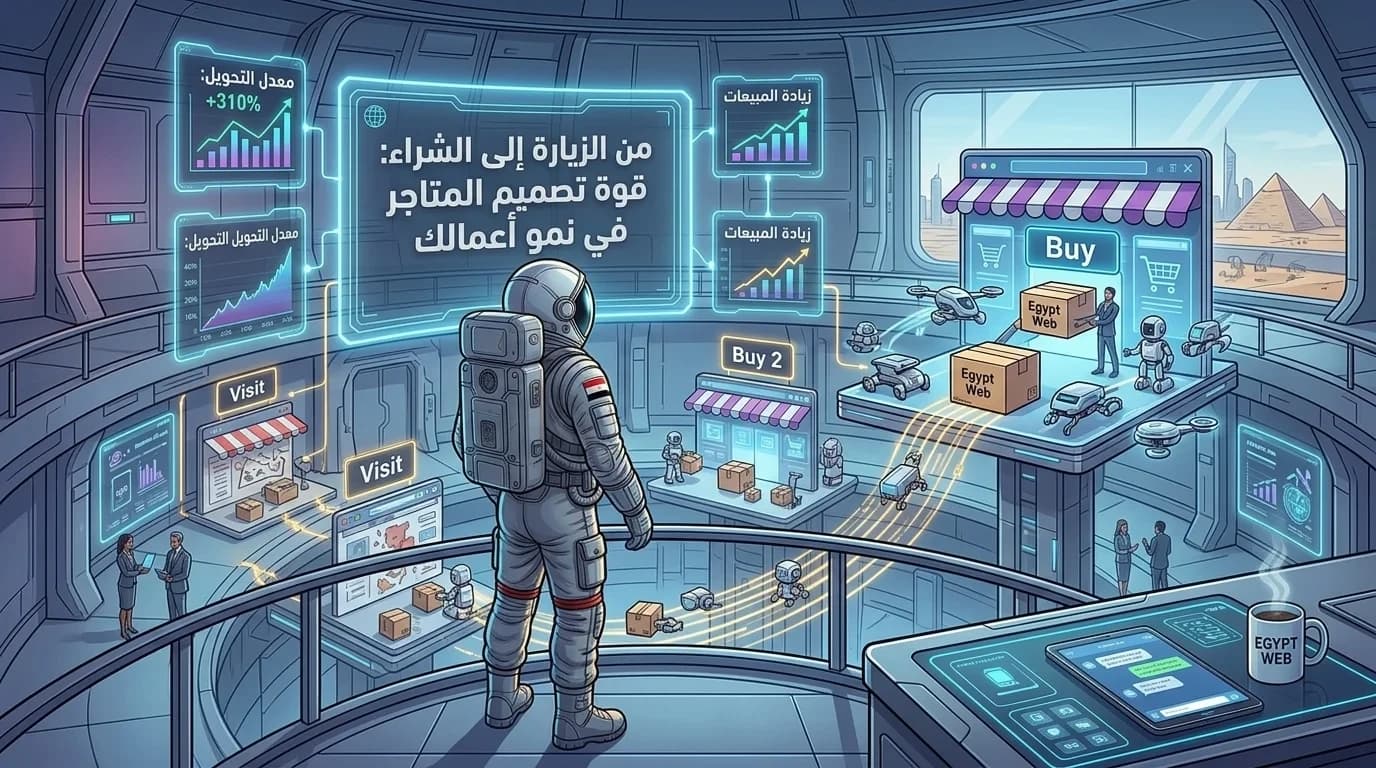
Owning an e-commerce store is no longer enough to generate sales. Success in digital commerce depends on a store's ability to attract visitors, help them find products, and turn their interest into actual purchasing decisions. You may spend a significant budget on advertising and marketing, but still lose potential customers if your website is slow or the checkout process is complicated. This is where e-commerce store design becomes important as an investment in customer experience and business growth. In this article, we explore the key elements of a successful online store, how to improve the shopping experience, and the role of continuous development and management in increasing sales and building customer loyalty in the Egyptian market.
How Does E-commerce Store Design Increase Sales?
Good design is not limited to colors and images. It organizes the customer journey from the moment visitors enter the store until they complete their orders. When visitors can understand the products, access prices, and find shipping details easily, making a purchasing decision becomes more straightforward. In contrast, a cluttered design or complicated navigation may encourage them to leave the website and look for an alternative.
To deliver a better experience, focus on the following elements:
A clear interface that reflects your brand identity.
Organized menus that help customers find product categories.
High-quality product images and accurate descriptions.
Visible, easy-to-use purchase buttons.
Clear information about prices, shipping, exchanges, and returns.
The design should also suit the nature of the business and its target audience. A clothing store has different requirements from an electronics or cosmetics store. The goal is to simplify the shopping journey and reduce obstacles that might prevent customers from completing their purchases.
What Are the Key Elements of Creating a Successful Online Store?
E-commerce store development begins with understanding the nature of the business, identifying the products and target audience, and selecting the appropriate platform and features. Early planning helps avoid the costs associated with changing the store's structure or redeveloping essential functions after launch.
User Experience and Responsive Design
Your store should work efficiently on smartphones, tablets, and computers, with clear fonts, touch-friendly buttons, and well-organized screens. Customers should also be able to search for products, apply filters, and review product details without unnecessary steps.
Payment, Security, and a Smooth Checkout Process
Provide payment methods that suit your audience, and display shipping costs and exchange policies before customers reach the final stage of checkout. Use a secure connection and appropriate measures to protect customer data while minimizing the number of fields required in the order form. The clearer and more straightforward the process, the fewer obstacles shoppers will face that might cause them to abandon their carts before completing a purchase.
E-commerce Store Development to Improve Performance and Google Visibility
The work does not end when the store launches. Continuous technical monitoring is necessary to maintain speed and stability and make products easier to discover through search engines. E-commerce store development includes optimizing code, reviewing pages, fixing errors, and updating features according to the business's needs.
Key areas of development include:
Improving page and image loading speeds.
Organizing category and product URLs clearly.
Writing unique titles and descriptions for every important page.
Adding structured product data when appropriate.
Fixing broken links and indexing issues.
Testing the store after updates to ensure that the purchasing and payment processes work correctly.
You should also monitor mobile page performance using appropriate analytics tools. Combining technical optimization with a positive user experience helps build a store that can grow over time, rather than focusing solely on appearance while neglecting the factors that influence customer acquisition.
E-commerce Store Management: How to Turn Visits into Sales
Online stores require daily management to ensure information accuracy, product availability, and prompt handling of orders and inquiries. E-commerce store management includes monitoring inventory, updating prices, managing promotions, reviewing orders, and analyzing visitor behavior to identify the reasons behind poor sales performance.
To improve results, start by monitoring key performance indicators such as conversion rate, average order value, cart abandonment rate, and traffic sources. If visitor numbers are high but purchases remain low, you may need to review prices, product details, or checkout steps instead of immediately increasing advertising spending.
It is also important to provide responsive customer service, send clear order updates, and handle complaints professionally. A positive experience not only helps complete the current sale but may also encourage customers to purchase again and recommend the store to others.
E-commerce Store Services Your Business Needs to Grow
Every online store has different needs depending on its size, product type, and stage of growth. A new business needs a solid foundation, while an established store may need to improve the shopping experience, connect its inventory to other systems, or optimize its marketing campaigns.
E-commerce store services that can support business growth include:
Store interface design and user experience optimization.
Development and integration with payment and shipping systems.
Search engine optimization and product page optimization.
Analytics setup and purchase tracking.
Content, promotion, and product management.
Digital marketing and advertising campaign optimization.
It is best to prioritize services based on the store's actual challenges rather than purchasing every service at once. For example, if the main issue is a slow website, improving performance may be a higher priority than launching campaigns to attract more visitors.
How to Choose the Best E-commerce Store Design Companies
Choosing the right partner depends on execution quality and an understanding of your business goals, not price alone. Before hiring one of the best e-commerce store design companies, review its previous projects, confirm its experience developing stores in industries similar to yours, and ask about support and maintenance after launch.
It is helpful to evaluate the company according to the following criteria:
A clearly defined scope of work, cost, and expected timeline.
High-quality mobile design and ease of use.
Attention to technical performance and SEO requirements.
The ability to develop the store as the business grows.
Clear ownership of accounts, data, and files.
Available technical support and a defined process for resolving issues.
You should also ask how the project will be handed over and whether your team will receive training on managing products and orders. A successful online store is more than an attractive website. It is a practical system that your team can operate and improve and that customers can use with confidence and ease.
Start Developing Your Store with TREE Marketing
Are you planning to launch a new online store or improve the performance of your existing one? TREE Marketing provides digital marketing, website development, and application development services, focusing on aligning design and user experience with business objectives. The process begins with understanding your business and target audience, followed by identifying the technical and marketing requirements that can help you create a smoother, clearer shopping experience.
Contact the TREE Marketing team to request a proposal tailored to your business needs and discuss the steps required to turn your online store into a sales channel that supports business growth in the Egyptian market.
Frequently Asked Questions About E-commerce Store Design
How Much Does E-commerce Store Design Cost in Egypt?
The cost varies depending on the number of products, required features, operating platform, payment and shipping integrations, and the level of design and development involved. It is therefore best to define your project requirements first to obtain a realistic cost estimate.
How Long Does It Take to Create an Online Store?
The timeline depends on the store's size, the complexity of its features, and how ready the content and products are. A simple store differs from a project that requires custom programming or multiple integrations, so the timeline is determined after agreeing on the scope of work.
Does E-commerce Store Design Affect SEO?
Yes. It can affect SEO through page speed, mobile experience, category and URL structure, and the ability of search engines to index product pages. However, design alone does not guarantee top search rankings. SEO also requires useful content and ongoing technical optimization.
Do I Need a Company to Manage My Online Store?
Not necessarily. The decision depends on the volume of operations, your team's experience, and the time available. However, working with specialists may be beneficial as order volumes increase or when you need to improve technical performance, marketing, and sales analysis.