

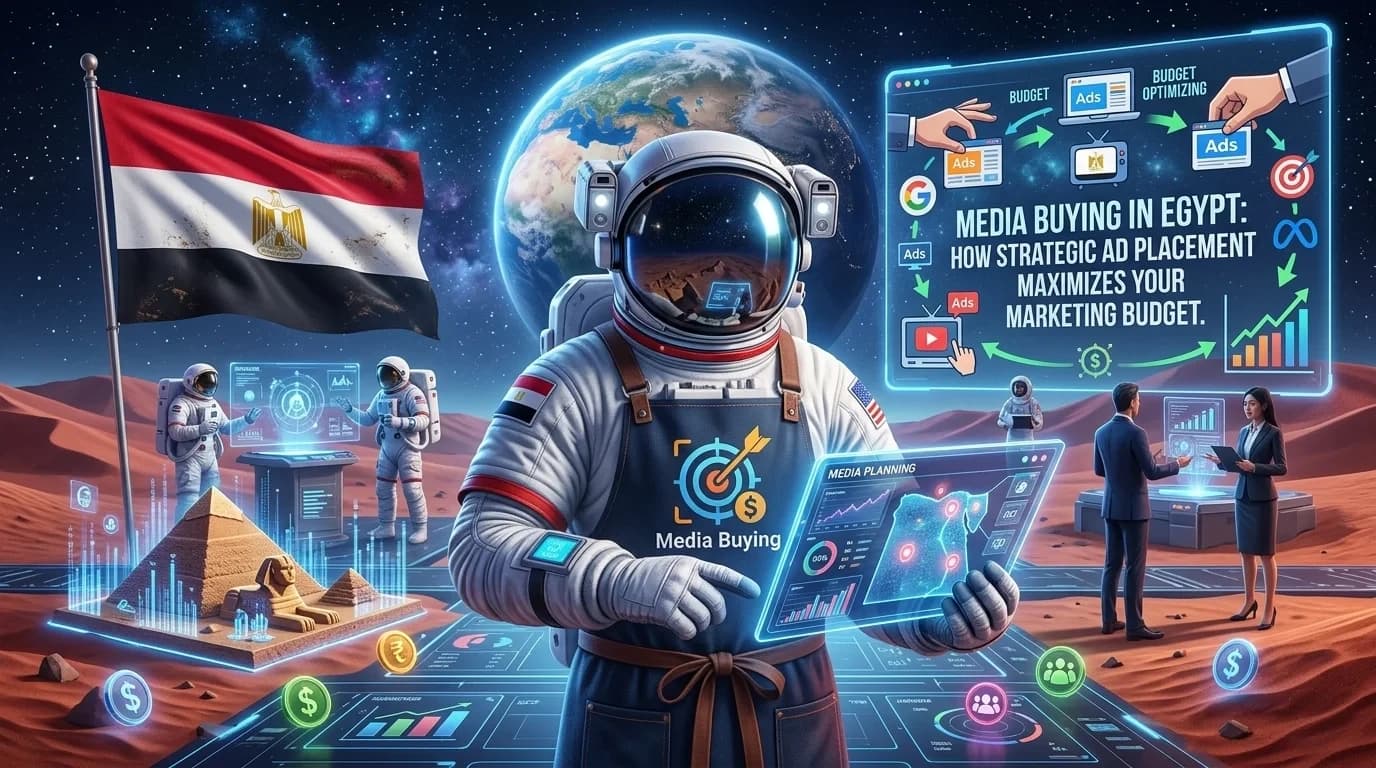
In a competitive market like Egypt, advertising success is not simply about spending more money. It depends on putting the right message in front of the right audience, on the right channel, at the right time. This is where professional media buying becomes important.
A strong media buying strategy connects business objectives with audience data, channel selection, placement decisions, and continuous optimization. Instead of treating advertising spend as a fixed expense, brands can use campaign data to identify what generates results and move budget toward better-performing opportunities. Modern media buying can cover search, social media, video, display, and traditional channels, depending on the campaign objectives.
What Is Media Buying in Egypt and Why Does It Matter?
Media buying is the process of securing advertising placements across relevant channels and managing those placements to achieve specific marketing objectives. It can include digital platforms such as Meta, Google, TikTok, YouTube, and LinkedIn, as well as traditional media such as television, radio, and outdoor advertising.
For Egyptian businesses, the challenge is not simply finding available advertising space. The real challenge is deciding which audiences, channels, placements, timing, and spending levels are most appropriate for the business.
A professional media buyer therefore looks beyond impressions. Campaign performance can be evaluated through metrics such as reach, frequency, clicks, leads, conversions, cost per acquisition, and return on ad spend.
Media Planning Egypt: Where Should Your Advertising Budget Go?
Media planning happens before and alongside the buying process. It establishes the strategic framework for how advertising money should be allocated based on the target audience, campaign objective, available channels, timing, and expected outcomes.
Effective Media planning Egypt should answer several practical questions:
Who are we trying to reach?
What action should the audience take?
Which platforms are most relevant?
How much budget should each channel receive?
What KPIs will determine success?
How long should the campaign run?
A good plan does not automatically mean spreading the budget across every available platform. In some cases, concentrating resources on fewer channels can create stronger reach, frequency, or conversion performance than dividing a limited budget too widely.
Media Buying vs. Media Planning: What’s the Difference?
Media planning and media buying are closely connected, but they are not exactly the same activity. Planning determines the strategic direction: the audience, channels, timing, budget allocation, and objectives. Buying turns that plan into actual placements and continuously manages campaign delivery.
How the Two Work Together
The relationship can be viewed as a continuous cycle:
Planning defines the campaign strategy.
Buying launches and manages the selected placements.
Performance data reveals what is working.
Budget and targeting decisions are adjusted.
Results feed into the next planning cycle.
This distinction matters because strong execution cannot completely compensate for poor planning. At the same time, an excellent media plan can fail if the buying, tracking, and optimization are weak.
How an Ad Placement Strategy Maximizes Marketing ROI
An effective ad placement strategy is about more than choosing a popular platform. It considers where the target customer is most likely to notice, understand, and act on the advertising message.
For example, a search campaign can capture users who are already expressing purchase intent, while social campaigns can help generate awareness, engagement, or demand. Video and display placements may support consideration, while retargeting can reconnect with users who have already interacted with a brand.
The objective is to match placement with intent rather than assuming that every impression has the same value. Media buyers can then compare results and adjust bids, audiences, creative, placements, or budgets according to campaign performance.
Choosing the Right Channels for Media Buying in Egypt
The right channel depends on the audience and the business objective. There is no universal platform that produces the best results for every Egyptian brand.
A campaign may combine:
Google Search: useful for capturing existing demand and high-intent searches.
Meta: suitable for audience targeting, awareness, lead generation, and conversion campaigns.
TikTok: useful for brands targeting audiences that actively consume short-form video.
YouTube: valuable for video-led awareness and consideration campaigns.
LinkedIn: relevant for certain B2B and professional audiences.
Outdoor advertising: can support broad geographic visibility and brand awareness.
The important point is that channel selection should follow audience behavior and campaign objectives rather than trends. A media buyer should also compare the quality of results generated by each channel, not just the amount of traffic or impressions delivered.
How to Manage Advertising Budgets Egypt Without Wasting Spend
Managing Advertising budgets Egypt effectively requires measurement before scaling. A business should know what its money is expected to achieve and have a reliable method for connecting advertising activity to meaningful outcomes.
Before increasing spend, marketers should establish:
A clearly defined campaign objective.
A realistic budget and spending period.
Conversion and analytics tracking.
Relevant performance benchmarks.
A process for reallocating underperforming spend.
Regular reporting based on business KPIs.
Tracking is particularly important because campaign dashboards can show clicks or impressions without necessarily explaining whether those interactions produced valuable customers. TREE, for example, describes measurement setup involving Meta Pixel, Conversions API, GA4 events, UTM tracking, and CRM or WhatsApp lead tracking as part of its media buying process.
What to Look for in a Media Buying Agency Cairo
Choosing a Media buying agency Cairo should involve more than comparing management fees. Businesses should evaluate how the agency approaches strategy, tracking, optimization, reporting, and accountability.
Questions Worth Asking Before Hiring an Agency
Ask whether the agency:
Builds campaigns around defined business KPIs.
Provides transparent reporting on spend and results.
Has experience with the platforms relevant to your audience.
Can explain how budget allocation decisions are made.
Uses conversion tracking and attribution appropriately.
Tests creative, audiences, and placements rather than relying on one setup.
Provides a clear process for optimization.
TREE states that its media buying team works across Meta, Google, TikTok, Snapchat, and LinkedIn, while its broader service offering also includes programmatic and out-of-home planning. The company says it has served more than 150 brands in Egypt since 2016.
How to Measure Media Buying Services and Campaign Performance
Good Media buying services should be evaluated against the business result they are designed to generate. A campaign focused on awareness should not necessarily be judged by the same KPI as an e-commerce conversion campaign or a lead-generation campaign.
Depending on the objective, useful metrics may include reach, frequency, CPM, CTR, CPC, cost per lead, conversion rate, CPA, revenue, and ROAS.
The most important step is connecting these numbers to actual business outcomes. If one campaign produces cheap clicks but few qualified leads, while another produces fewer clicks but more customers, the second campaign may be more valuable despite having a higher CPC.
Optimization should therefore focus on business value, not simply on achieving attractive dashboard numbers.
Turn Your Advertising Budget Into Measurable Growth
Choosing the right media strategy can make a significant difference in how efficiently a brand uses its advertising budget. Instead of launching campaigns based on assumptions, businesses can combine audience research, strategic planning, precise placement, reliable tracking, and continuous optimization.
TREE provides media buying and broader advertising services for brands operating in Egypt, with campaign planning and optimization across major digital advertising platforms. Businesses interested in evaluating their current campaigns can request a quotation or speak with the agency about their objectives and budget.
Frequently Asked Questions
What is media buying?
Media buying is the process of purchasing advertising placements across digital or traditional channels and managing those placements to reach a target audience efficiently. It can involve negotiation, bidding, budget management, placement selection, and ongoing campaign optimization.
What is the difference between media buying and media planning?
Media planning determines where, when, and how an advertising budget should be used, while media buying executes those decisions by securing placements and managing campaign performance. The two functions work together throughout the campaign lifecycle.
How much should a business spend on advertising in Egypt?
There is no single budget that works for every business. The appropriate amount depends on the objective, target market, customer value, competitive environment, sales cycle, channels, and expected return. A useful starting point is to define the business KPI and work backward to determine an affordable acquisition cost.
How can I choose the right media buying agency?
Compare agencies based on their strategy, relevant industry experience, tracking capabilities, transparency, reporting, optimization process, and understanding of your target audience. The cheapest agency is not necessarily the most cost-effective if poor execution leads to wasted advertising spend.
Why is ad placement important?
Ad placement determines where and when an audience encounters an advertisement. A relevant placement can improve the likelihood that the message reaches people who are more likely to notice, engage with, or act on it. Effective buying therefore considers audience relevance, context, timing, cost, and measurable performance.